Wednesday, July 28, 2010

Patience

Blue Nude
Pablo Picasso

Poetry Wednesday

Patience
Rabindranath Tagore

If thou speakest not I will fill my heart with thy silence and endure it.
I will keep still and wait like the night with starry vigil
and its head bent low with patience. 
The morning will surely come, the darkness will vanish,
and thy voice pour down in golden streams breaking through the sky. 
Then thy words will take wing in songs from every one of my birds' nests,
and thy melodies will break forth in flowers in all my forest groves. 

Wednesday, July 21, 2010

Amisaganalu

Duke Mu of Chin said to Po Lo: "You are now advanced in years. Is there any member of your family whom I could employ to look for horses in your stead?" Po Lo replied: "A good horse can be picked out by its general build and appearance. But the superlative horse- one that raises no dust and leaves no tracks- is something evanescent and fleeting, elusive as thin air. The talents of my sons lie on a lower plane altogether; they can tell a good horse when they see one, but they cannot tell a superlative horse. I have a friend, however, one Chiu-fang Kao, a hawker of fuel and vegetables, who in things appertaining to horses is nowise my inferior. Pray see him."

Duke Mu did so, and subsequently dispatched him on the quest for a steed. Three months later, he returned with news that he had found one. "It is now in Shach'iu," he added. "What kind of a horse is it?" asked the Duke. "Oh, it is a dun-colored mare," was the reply. However, someone being sent to fetch it, the animal turned out to be a coal-black stallion! Much displeased, the Duke sent for Po Lo. "That friend of yours," he said, "whom I commissioned to look for a horse, had made a fine mess of it. Why, he cannot even distinguish a beast's color or sex! What on earth can he know about horses?" Po Lo heaved a sigh of satisfaction. "Has he really got as far as that?" he cried. "Ah, then he is worth ten thousand of me put together. There is no comparison between us. What Kao keeps in view is the spiritual mechanism. In making sure of the essential, he forgets the homely details; intent on the inward qualities, he loses sight of the external. He sees what he wants to see, and not what he does not want to see. He looks at the things he ought to look at, and neglects those that need not be looked at. So clever a judge of horses is Kao, that he has it in him to judge something better than horses."

When the horse arrived, it turned out indeed to be a superlative animal.

Raise Hight The Roof Beam, Carpenters, J.D. Salinger

Since our arrival to Addis Abbaba, Ethiopia, over five weeks ago, I struggled over how I would choose to describe this city once I returned. You see, I have awakened to the sound of men busy with spraying down cobbled streets with water and viewed the awesome majesty of a bygone church upon opening my hotel window while in Paris. I have peered down sixteen stories at the city of Seoul, alive, vibrant, booming with activity and neon lights. I have lounged in cafes late at night with new friends in Skopje, Macedonia, drinking in the smells of freshly cooked beef kebobs and stale cigarette smoke while surrounded by ruined fortresses and stalwart bridges dating back to Roman rule. To the outward appearance (and here I must qualify that my experience of Ethiopia's capital was indeed severely limited), there is much of Addis that may not appeal to the senses. But even though the mud drenched streets after an afternoon rain; the scattered cattle and the beggars; the commotion of traffic spewing diesel exhaust and following what no Americans would consider the "rules of the road," was certainly not as charming as a stroll down the Champ de Elysee: Addis, I discovered, possessed its own superlative beauty. For underneath the muck and havoc, the poverty and despair, beneath the externals of the city, there is a people so lovely, so kind, so generous. And in my heart, those "homely details" have begun to fade and it is this beauty I continue to treasure in my heart.


I am not sure why, but we could not get enough pictures of cattle on the sidewalks. I think Thomas was a bit envious. 


After taking custody of Lucia on Monday, we were told by our agency that if Jared and I were going to be out and about Addis that we take her next door to the Holt Care Center where she had been living. These precious women were two of her nannies. These pictures are so dear. So totally overwhelming, swimming in gratitude for the love and care our daughter received while in Holt's care. 


And look Molly, it is your dress! The nannies were always very concerned with the warmth of the children, hence the shirt underneath the sundress. 


Several months ago, Cami Blumenthal raffled off a fuzzy, pink blanket in order to raise money to purchase medicine for AHOPE. She was able to raise $200 and I won the blanket. As providence would have it, Cami and her husband Ryan were part of our travel group and Jared, Ryan, Thomas, and I were able to visit AHOPE, a care center for children with HIV/AIDS and drop off the medicine.


Throughout the summer months AHOPE receives many volunteers (do you hear the wheels turning in my head?). Some chalk drawings from some of AHOPE's children. 


We toured AHOPE's early childhood facility during nap time. This is Thomas in the toddler room. With the help of medicine now available to countries like Ethiopia, the life expectancy of children with HIV/AIDS has increased to twenty-two years of age. 


A classroom for children not enrolled in the Addis school system.


After a night of severe illness for both Jared and myself, we awakened and though a bit weak went on a tour of Holy Trinity Orthodox Cathedral. Though not the Byzantine style which we are pretty accustomed to, the cathedral was beautiful and is the resting place of former Ethiopian Emperor Halle Selassie and his wife. 


One of the four Evangelists (we think it's St. John) outside the Cathedral.


Praying outside the Cathedral doors.


Though not typical to our Orthodox experience, the stain glass windows depicting biblical scenes were beautiful.  


Though we have always requested a bassinet for our flight home with our children, this was the first time we actually had one. Wonderful and so was she for our nearly twenty hour flight home. Thanks Jared for doing all the baby duty!


So Jared and Thomas loved these moths that were abundant in Addis.


Anything. Anything. Anything is better than our trip home from Seoul with the twins. Three seats for five people. This time we had five seats for the four of us. And after our sickness Wednesday night/Thursday morning, even the airplane food was a feast.


Thomas with his new Ethiopian shirt (it has a gold cross on it). Fabulous traveler. Not surprised in the least at this.


Arriving in Chicago.

And so ends the pictures of our journey. You can visit our dear friend's blog for  photos of our arrival home here. And if you want to view more great photos of our trip including one shot of our travel group at the Care Center's Good-bye Ceremony, you can visit my friend Julie's blog.

Amisaganalu.
(Thank You in Amharic)

Sunday, June 27, 2010

Surprised by Ethiopia

If you've ever used the phrase, "It's Africa-hot out here," you're likely an ignorant American like myself, assuming one of the planet's largest landmasses has a nearly homogeneous climate. Knowing I was heading for Africa, which in my mind consisted entirely of deserts and jungles, both of which are hot, I only packed one sweater and one long-sleeve shirt for this trip. Ethiopia, to my surprise, is a highly mountainous region and actually quite cool. Additionally, we were there during the rainy season, their winter equivalent, so the daily temperature regularly topped out in the mid-70s. I wore that one sweater every night. I think it is the many surprises like this one, surprises that chipped away at the cliche images American media put in my head (think Sally Struthers and starving children) and made me proud of the birthplace of my daughter.

I knew I was going to experience an under-developed nation and likely be left wanting for many American niceties. I was not wrong. But I was surprised to discover an extremely industrious people, literally turning tin shanties into internet cafes along the rural roads to Durame. Construction was going on everywhere throughout Addis Ababa. Ethiopia, after years of falling apart under a Communist regime, really seems to be a nation under development.

I was conditioned to expect poverty on a scale I couldn't even imagine. And I was not wrong. The beggars sitting outside the Church gate in Durame only briefly opened for me a window on the vacuous poverty of such places. However, I also discovered a culture so rich in heritage and tradition as to dwarf my own. Ethiopia is the seat of the African Union and the only African nation never to be colonized. Ethiopia is likely the worlds oldest culture, but also home to Emperor Hallie Salise, one of the foundational figures of 20th century politics.

I had learned before traveling that Ethiopia was a majority Orthodox Christian nation, the oldest in the world, but I could never have predicted the ways this would affect the culture - the most popular beer in town is named St. George (not St. Pauli Girl), the airline offered fasting meals (labeled fasting, not vegetarian or vegan), Christian prayers (not Muslim as in much of the Middle East and Africa) were broadcast into the streets starting at 4:30 AM as the priests at the local churches began preparing for their daily services.

A week is never enough to truly get to know a culture, but it is often just enough to fall in love. I am honored to have met such a glorious culture and cannot wait to return.


Here are a couple more picture I snapped of Durame in the morning before we began our journey back to Addis Ababa.


We made a brief but meaningful stop at this medical clinic near Durame. This clinic averages two births a day and is remarkably rough by American standards. However, the young doctor here and his team have had a profound impact on the surrounding community. Holt, the agency through which we arranged our adoption, in keeping with their commitment to keep birth families intact, is currently raising funds to add a surgery center to this clinic. Any money you donate will be money well spent.


A van-full of Americans driving by was apparently reason enough to abandon studies at this school.


Thomas took a moment to explore the Ethiopian countryside.


Thomas snapped this picture of the cows.


Here a couple close-ups of the huts that dotted the landscape between Addis Ababa and Durame.


Children quite literally came out of the woods in the most seemingly remote locations to ask treats of the American tourists.


Yes, they grow corn in Ethiopia. It was just like being back in Iowa.


Thomas took yet another picture of a cow.


I photographed these cows. These are the types of obstacles our driver expertly maneuvered around on our way to and from Durame.


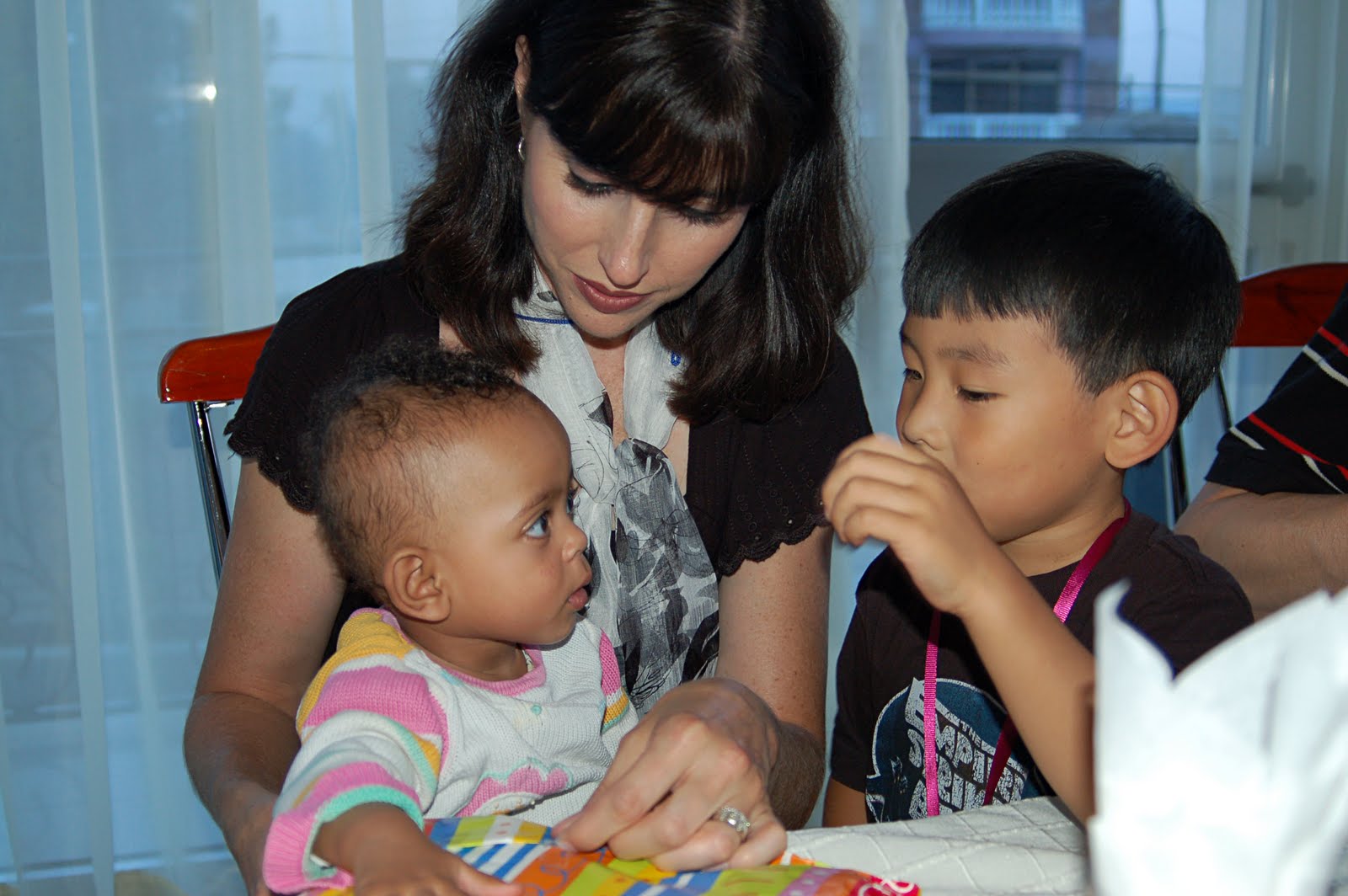
And then, upon our return to Addis Ababa, we finally took custody of baby Ethiopia. Here she is opening a gift Thomas had brought along.


This last picture is particularly precious when you realize Thomas has been calling Lucia his twin and then compare it with this photo taken the first night Russell and Elliot slept with us. He may be onto something.

Thursday, June 24, 2010

Sojourn in Durame

"I have scars on my hands from touching certain people...Certain heads, certain colours and textures... leave permanent marks on me."
J.D. Salinger, Raise High the Roof Beam, Carpenters and Seymour: An Introduction

It had been a fitful night of sleep as my body still desperately attempted to come to terms with an eight hour time difference and my mind raced with thoughts of the unknown day ahead. Besides meeting my daughter for the first time, the day now approaching was guaranteed to be one of those unforgettable moments of my life, pregnant with a significance so profound that I perhaps will never fully grasp it. Our travel group was scheduled to leave Addis at 6:30 AM, crowding into two vans like members of a church youth group journeying to a weekend retreat, for a six hour trip to southern Ethiopia, the region in which all of our children had been born. Not only would we visit the Care Center in Durame, where our sons and daughters had lived prior to their home in Addis, but most importantly, we would be meeting with members of their birth family. Soundly my husband and son appeared to rest while I struggled to coax myself back into unconsciousness. Surrounded by the heavy, forsaken darkness of a day not yet occupied with light, I began to hear the prayers being offered by Orthodox clergy broadcasted by a loudspeaker on a nearby church and reasoned that it was around 4:00 AM. Feeling alone, I was comforted by the haunting chants of words I did not understand knowing that Christ was in the midst of my solitude.

We were welcomed into a room not much larger than your average office space and took our places in chairs lined up in rows and around the walls. Each family was handed a list which divided us up into three groups and indicated the order of the birth family meetings. Jared and I were listed last. Robotically our lips formed words casual and light, void of any true meaning. Nervously we laughed and pretended to be occupied with drinking the coffee and eating the popcorn we were graciously served. All the while, we were really seeking to lessen the weightiness of our imminent experience by engaging in pedestrian activities. Collectively our lives were on pause while in a building adjacent to ours another group of individuals with lists in their hands likewise anxiously awaited to be summoned.  

Durame. Just typing the name elicits within me contrasting images of beauty and ugliness, as well as  feelings of hope and despair. Perhaps we all were wounded during that twenty-four hour period in ways we could not have imagined. Wounded as we viewed the Ethiopian countryside lush and beautiful with its seeming simplicity, but often harsh with poverty; wounded as we encountered multitudes of children whose lack of basic necessities like proper fitting shoes and clothing or clean water, made us want to hide our American faces in shame; wounded because what we gained—our precious children—came at a grievous, irrevocable price for those men and women with whom we shared twenty minutes of our lives; wounded as we silently yielded to their abrupt departure, watching them being shuffled back into vans and returned to places that will probably remain forever unknown to us.

Day Three: The Drive to Durame


There were frequent stops along the way for animals in the road. In this particular instance you can see three donkeys, a goat, and a dog.


We also has to stop for these baboons.


I think these are peacocks, but I may be wrong.


These huts were the regular form of habitation found in the rural areas between Addis Ababa and Durame.


Show this to your child the next time he doesn't want to carry his dishes to the sink.


As we drove the six hours, we witnessed countless people collecting and carrying water from less than pristine sources. We never tire of plugging one of our favorite charities—Charty: Water—who is working to solve this issue.


Thomas made some new friends at the Durame Care Center.


This lovely quartet sat perched over our hotel. In the middle of the night, as I sprayed myself with Off and thanked God for malaria meds, I swear I heard strains of a barber shop quartet singing the song from Disney's Jungle Book, "We're your friends. We're your friends. We're your friends to the bitter end."